Contractions are intense. Fortunately, your body has natural mechanisms to help you cope with pain. With the right techniques, you can reduce the intensity of contractions and make your birth experience more positive. This article helps you discover how to use your own strength to get through labour.
Find distraction
In the early stages, try not to focus too much on the contractions. They are usually still manageable. Keep doing what you were doing for as long as possible — find distraction. Read, watch TV, listen to music, or do something that relaxes you.
Try different positions
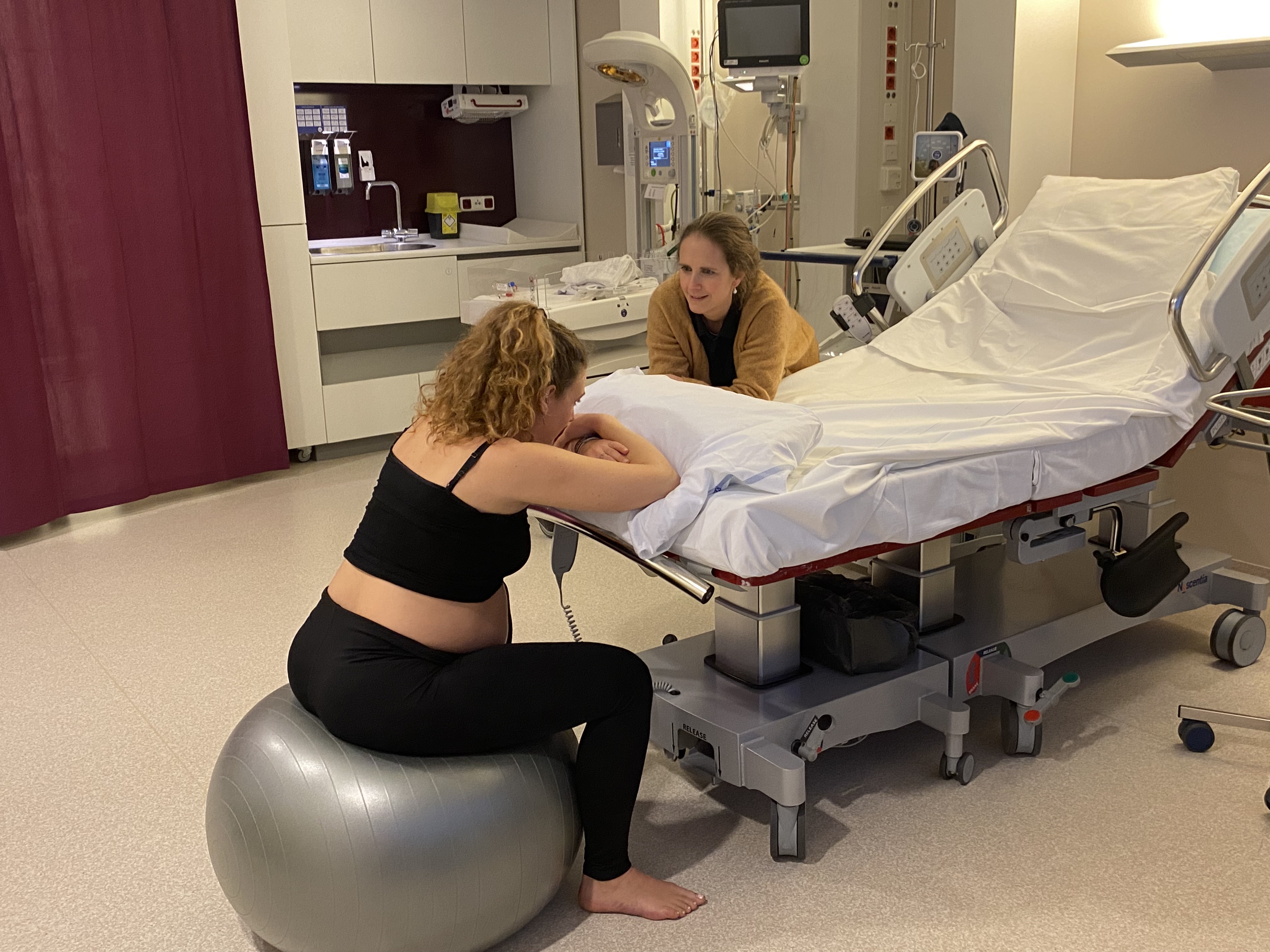
As contractions become stronger and more painful, it can be harder to relax. Go to a place where you feel comfortable and experiment with positions that help you stay relaxed. You might stand while gently rocking your hips or leaning on a chair or table. For back labour, being on your hands and knees can help. You can also sit on a stool and lean forward on a table. If you prefer lying down, try lying on your side with a pillow between your legs or under your belly and back. Walking can also be helpful. Try what feels best for you!
Most importantly, avoid tensing up or holding your breath as a contraction starts. Let your body stay loose and keep breathing steadily — this helps you feel less pain. For more inspiration, see the leaflet Which birthing position suits you?
Keep yourself warm
Warmth helps you relax. Make sure the room temperature is comfortable. Wear warm, loose-fitting clothes. When lying down, you can place a hot-water bottle on your belly or back. A warm bath or shower can also be very soothing — many women enjoy the feeling of warm water on their belly or back. The warmth helps your body relax, which reduces the perception of pain.
Count down: every contraction brings you closer
Think positively — believe that you can do this. Tell yourself: this contraction is over and won’t come back. And don’t be hard on yourself if it feels too much for a moment. Let us or your birth partner encourage you. Every contraction brings you closer to holding your baby in your arms.
Focus on your breathing
Your breathing is one of the most powerful tools you have during labour. Following your breathing rhythm helps you stay calm and less focused on the pain. This relaxation allows you to handle contractions more effectively. Keep breathing slowly — in, and then out over four counts. Conscious breathing not only helps you cope with pain but also supports your body’s natural rhythm.
Why does it work?
When you’re tense, your breathing becomes shallow, which increases stress. Deep, slow breathing activates your parasympathetic nervous system — promoting calm and relaxation.
Techniques to try:
- Deep belly breathing: Breathe in slowly through your nose, let your belly expand, and exhale gently through your mouth.
- Focused exhalation: Breathe in through your nose and exhale as if softly blowing out a candle — helpful during strong contractions.
- Breathing with visualisation: Imagine breathing in calm and strength, and exhaling tension with each breath.
Massage — or not
A gentle massage of your lower back or legs can be soothing as contractions intensify. It helps distract from the pain and prevents stiffness. Some women prefer firm pressure on their lower back with two fists. Try it out and let others know what feels right or not. If you don’t want to be touched at all, that’s perfectly okay — say so!
Mindfulness during labour
Mindfulness can be a powerful way to stay present, calm, and accepting during labour.
What is mindfulness?
Mindfulness means being fully aware of the present moment without judgment. It helps you respond calmly to the sensations and emotions that arise during labour.
How does mindfulness help with contractions?
- Greater pain acceptance: Focusing on your breath or bodily sensations changes how you experience pain.
- Less stress: Mindfulness helps reduce fear and panic, allowing you to stay calm.
- Improved focus: It keeps you connected with your body and the birth process.
Mindfulness exercises to try:
- Body scan: Slowly bring your attention to different parts of your body and observe what you feel without judgment.
- Breath focus: Focus completely on your breathing rhythm without trying to change it.
- Observing thoughts: Notice thoughts like “this is too painful” and let them go without engaging with them.
- You can learn this technique in a mindfulness course.
Understanding hypnobirthing techniques
Hypnobirthing is about creating a deep state of relaxation, trust, and focus during labour. The idea is that fear and tension increase pain, while relaxation can make the experience more gentle.
How does hypnobirthing help with contractions?
- Reduces fear: Positive affirmations and visualisations help you build a calm mindset.
- Encourages relaxation: Special breathing techniques help you stay in a deep, restful state.
- Builds confidence: Preparing with hypnobirthing helps you trust your body and inner strength.
Example exercises:
- Positive affirmations: Repeat phrases like “My body knows what to do.”
- Visualisation: Picture a calm place — a beach or forest — and breathe in rhythm with the waves or the wind.
- You can learn these techniques in a hypnobirthing course.
Changing positions and upright postures
Giving birth doesn’t have to happen lying down. In fact, many women experience less pain and faster progress when they try different upright positions.
Benefits of upright positions:
- Better use of gravity: Helps your baby move deeper into the pelvis.
- Less pressure on your lower back: Eases back pain.
- Improved circulation: For both you and your baby.
Positions to try:
- Standing and leaning: Against a wall or your partner.
- Hands and knees: Reduces back pressure and can help the baby rotate.
- Sitting on a birth ball: Provides support and allows gentle movement of the hips.
Summary: What works for you?
Every birth is different. What works for one person may not work for another. The most important thing is to trust your body and explore what feels right for you. Breathing, relaxation, movement, and warmth together can make a big difference.
Keep listening to your body and share your wishes with us. Remember: you are the expert on your own body. We’re here to support you — whatever you choose.