Sometimes it’s necessary to help start labour — this is called an induction. This may be advised if your pregnancy goes beyond term, if there are concerns about your health or your baby’s health, or if your waters have broken but contractions don’t start on their own.
There are several ways to induce labour:
Membrane sweep
Membrane sweep
A membrane sweep is a natural way to stimulate labour. It is done by the midwife, either at home or in our practice. During an internal examination, we check whether your cervix has started to open. If so, we can gently make circular movements with a finger around the cervix. This helps release natural hormones that may trigger contractions.
The procedure can feel slightly uncomfortable, and you may experience some light bleeding afterwards. If it works, contractions usually begin within 20 hours — this happens in about 17% of women. If nothing happens, the procedure can be repeated. Possible downsides are that it may feel unpleasant or cause irregular contractions without real progress.
Breaking the waters
Breaking the waters
When the cervix is soft and open enough (usually around 2–3 cm dilation), the membranes can be broken. This is done during an internal examination using a small hook. You’ll feel the warm fluid leaking out, but it shouldn’t be painful.
After the waters are broken, we expect contractions to start within 12–36 hours to reduce the risk of infection. About 90% of women go into labour within 24 hours.
Both membrane sweeping and breaking the waters can be done by us. If a balloon catheter or oxytocin drip is needed, we will refer you to secondary care (the hospital), where your labour will continue under their supervision.
Balloon catheter
Balloon catheter
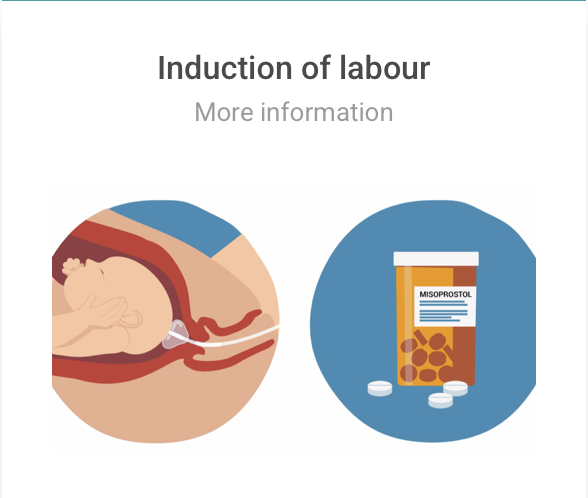
If the cervix is still closed, labour can be induced using a balloon catheter. This is a thin tube with a small balloon at the end, placed just inside the cervix and filled with sterile water. The pressure helps the cervix soften and sometimes begin to dilate. The balloon may also stimulate the release of hormones that can start contractions. After about 24 hours, the balloon is removed or may fall out on its own. Once enough dilation has occurred, the membranes can then be broken.
Oxytocin drip
Oxytocin drip
If contractions do not start on their own, you may receive synthetic oxytocin through an IV drip. A small flexible tube is placed into a vein and connected to a pump that controls the amount of oxytocin given. The infusion always starts at a low dose, which can be increased gradually if needed. Inserting the needle may sting briefly, but once the needle is removed, the tube itself is barely noticeable.
Information video from the gynaecologist about induction of labour.