To help you understand what’s written in the sonographer’s report, we’ve listed the most common abbreviations and their meanings below.
- EDLM: The First Day of your Last Menstrual Period (LMP)
- G/P: Number of pregnancies (Gravida) and number of births (Para)
- A terme: Your due date
- CRL: Crown Rump Length — the measurement from the top of the head to the baby’s bottom
- BPD: Bi-Parietal Diameter — the distance from ear to ear
- HC: Head Circumference
- AC: Abdominal Circumference
- FL: Femur Length — the length of the upper leg bone
- EFW: Estimated Fetal Weight — the estimated weight of the baby at the time of measurement
- Dp: The deepest pocket of amniotic fluid in the uterus
- AFI: Amniotic Fluid Index — an overall measurement of the amount of amniotic fluid
Baby’s size: the ‘p-value’
A baby’s measurements are expressed as a percentile, the ‘p-value’.
– P50 means 50% of babies at this stage of pregnancy are larger and 50% are smaller — in other words, exactly average.
– P20 means 20% of babies are smaller and 80% are larger.
These p-values are based on averages for Dutch babies and don’t take the parents’ size into account. So if you’re taller or bigger than average, it’s quite likely your baby will be too.
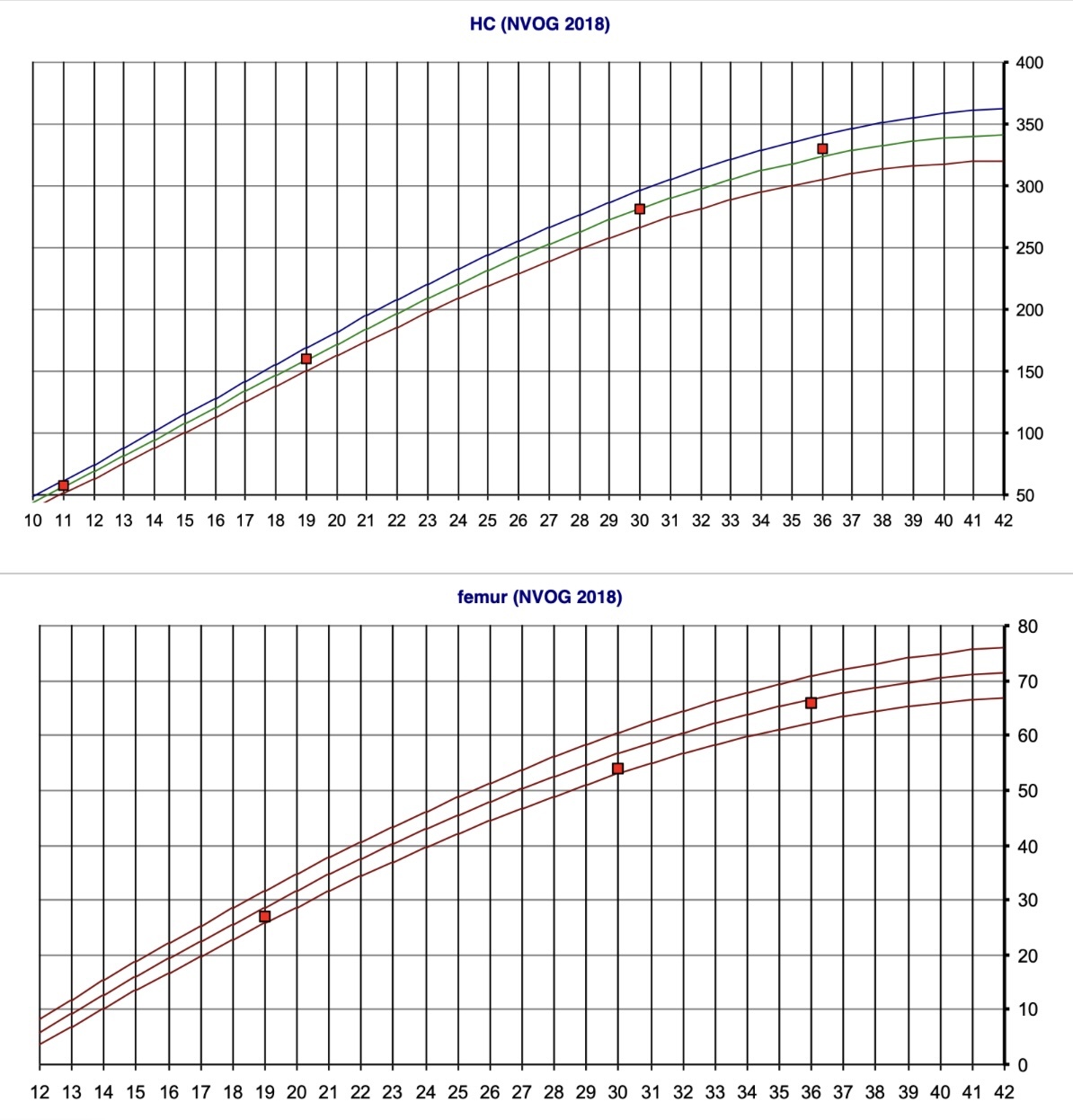
What’s considered normal?
No baby has all measurements exactly on the P50 line. Measurements between P10 and P97.7 are all considered normal. If an ultrasound shows measurements below P10 or above P97.7, we may choose to monitor your baby’s growth more closely. If your baby continues to grow steadily along their own curve, there’s usually no reason to worry. However, if growth suddenly slows, we’ll investigate to check whether your baby is getting enough nutrients. If growth speeds up rapidly, we’ll also look into the cause — sometimes it’s due to gestational diabetes, or simply a normal growth spurt.